Friday, January 8, 2021

Jan 8 Francis Beidler Forest


I learned of this place several years ago and have wanted to visit it. I recall years ago seeing it on a map but with no clue as to what it was, there was not an interest in it. After visiting Congaree several times, I knew this would be a special place as it was the second largest old growth forest in SC behind Congaree.

It's a swamp. Sound exciting? What is a swamp? A swamp is a forest that is sometimes but not always, under water. Not to be confused with a marsh - a flooded grassland. Around here, there are also pocosins which are poorly drained flat forest. And, of course, the mysterious Carolina bay lakes which I recently blogged about here.  More specifically, this is a Cypress-Tupelo swamp. The Bald Cypress trees are significantly larger and older than the Tupelos. The oldest Bald Cypress here is said to be 1500 years old. That is a mere teenager compared to the Bald Cypress trees in the Three Sisters swamp along the Black River in NC. The latest core dating done there has a tree pegged at 2223 years old. I have floated through the Three Sisters swamp twice and those trees are immense compared to what I saw today. 


The 1.75 mile long boardwalk is the way to see the swamp. In a Covid world, you have to make reservations up to a month in advance and have to be in and out between 9 and 1 on the day of your reservation.  As we drove up, we called to check in, gave our names and ticket number and were told to have a great time, call us if you have any questions.


In a non-Covid world, this is where you'd meet to get a lecture on the swamp, by the "Meeting Tree".


September 21, 1989 Hurricane Hugo blew through here. It made landfall just south of Myrtle Beach and roared inland. In this forest, it uprooted hardwoods and broke Pines in two or knocked out their branches but the Cypress stayed in place. Except the one above. It toppled and took out a section of boardwalk, in the foreground. In all, about 1/3 of the boardwalk was destroyed that night. My condo in Cherry Grove rode out the storm with minimal damage. A couple days later, I rode down with a friend to see properties his bank owned and how they fared. I recall the incredible devastation through the Coastal Plain. Entire Loblolly plantations were destroyed.  


Cypress knees - what's the point? Nobody is sure but it is thought that they create stability. On dry land a Cypress may not have a knee or just one or several. In water, Cypress have many and they can be very large.

It doesn't look like a 7 ft high knee, but it is.


I know it is named the Francis Beidler Forest but this swamp has another name, Four Holes Swamp. The name dates back to the 1700s but no one remembers why it is named that. It is about 60 miles long and covers 40,000 acres, drains 430,000 acres and drops about 30 feet in elevation before it empties into the Edisto River. Right where we walked, the elevation was between 55 and 60 feet above sea level. We drove an hour and half from Kiawah Island to get here. I don't recall any hills. 


It was a dreary and cold day with some light drizzle. We didn't hear much. A Barred Owl and Pileated Woodpecker made their presence known. The water looked still but where there was an obstruction, you could see it moving.

An inter-species affair in the swamp.

Knees at attention.

A bald knee of a Bald Cypress.


Jan 7 ACE Basin hikes


Today's hikes are within the ACE Basin area. The Grove Plantation is the headquarters for the National Wildlife Refuge. Built in 1828, the house and property have changed hands numerous times until sold to the Nature Conservancy in the 1990s. Although closed during the pandemic, the grounds are open and spectacular. Several acres of massive Live Oaks surround the house.


Since this was once a rice plantation, there are numerous ponds and dykes. It is the perfect place for wildlife, especially birds. We saw Wood Storks, Bald Eagles, Pileated Woodpeckers and many more. A Screech Owl was also present.


Spanish Moss is not a moss nor a lichen. It is a flowering plant which has no roots. Water and nutrients are absorbed through the leaves. The flowers are tiny and inconspicuous. Live Oaks are a favorite host tree due to high yields of nutrients residing on the tree. Resurrection Fern also grows on the trunk and branches of these trees. 

Wood Stork

Rice dyke


It is thought rice came to America in 1685. Henry Woodward obtained a bag of rice from Madagascar. He planted it to use as seed and the rice economy had begun. Enslaved Africans supplied the labor. Often they were advertised as coming from areas of Africa which were known for rice cultivation. Rice made SC the wealthiest of Southern states and 2nd wealthiest of all states. The Civil War was the end of that dominance. Although rice is not grown here now except in very small quantities, 85% of rice consumed in the US is grown in the US. The 6 largest producers are Arkansas, California, Louisiana, Texas, Mississippi and Missouri.


Our next hike is at a county nature preserve near the Edisto River. A trail and boardwalk makes a large loop through a Cypress swamp. There are some historical landmarks throughout the hike. A phosphorous operation has been totally reclaimed by the swamp. It was used during the Civil War. A barge canal which can still be seen, was dug from the factory site to the Edisto River.

I guess it gets wet here.

The work of a Yellow Bellied Sapsucker I think.

The roots of this Live Oak seem quite shallow.


Thursday, January 7, 2021

Jan 6 Woods Bay


Woods Bay State Park is a tiny state park in the South Carolina coastal plain just a few minutes from I-95. It is about half way from our home to Charleston SC. So it is the perfect place for a driving break. Much nicer than an I-95 rest area. There was no one here today. No visitors, no staff, just us.


After a pleasant lunch in the picnic shelter, we walked the boardwalk in a Cypress Swamp and a nature trail around the Carolina bay lake. Carolina bay lakes are elliptical shaped shallow lakes with a Northwest/Southeast orientation. There are hundreds of thousands of them from Florida to Delaware but NC and SC have the largest concentration. Origins of the lakes have been debated for a century. Early aviation was when the scope of the lakes were revealed. Prior, they were just wet areas that people tried to drain. It is thought 97% of the bay lakes in SC have been destroyed. 

Pollen studies and core samples indicate that the lakes were formed episodically over tens of thousands of years. Perhaps as long ago as 100,000 years. Their NW/SE orientation is consistent with wind direction during the Wisconsin glaciation. The most accepted theory is that as the sea receded leaving irregular shaped depressions of water, NW winds shaped the lakes. The NW end of the lakes is quite shallow and sandy while the SE ends are deeper and peaty. Having walked around several, this is quite evident. 


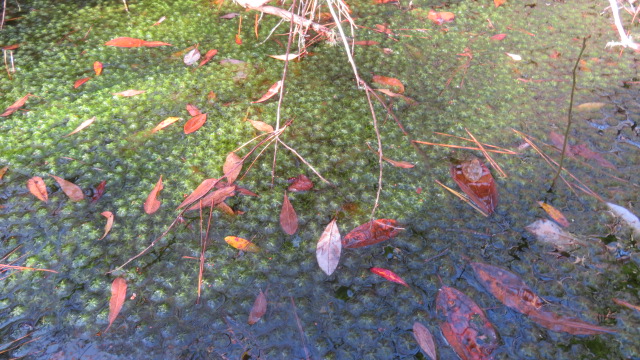
This looks like club moss growing in the water. I doubt that is what it is. Whatever it is, it has a beautiful appearance.


Cypress knees


Monday, January 4, 2021

Dec 22 Mt Shepherd


Without a doubt, it is the clearest day I have ever visited the observation tower at Mt Shepherd. This is the view south which doesn't have many notable landmarks. The view west included Charlotte which I have never seen here previously.


Looking north, Pilot mountain can easily be seen. And the Blue Ridge beyond was visible.


Our jaunt around the property included a short detour to this hand dug, rock lined well and the check dam below.


There appears to be a grove of blueberry bushes out in the forest. These seem to have been placed here as they look like a large patch of domesticated bushes.


Atop Little Mountain is an old water tower. Peter must have used a ladder to add that graffitti.

Tuesday, December 15, 2020

Dec 13 Carolina Tiger Rescue


Located outside Pittsboro near the Haw River, is Carolina Tiger Rescue, a non-profit home for rescued exotic cats. Originally begun in 1973 as the Carnivore Evolutionary Research Institute by UNC geneticist Dr Michael Bleyman as a breeding facility, it later evolved into a rescue sanctuary. Dr Bleymon's original mission was to breed exotic cats which were in danger of extinction. His desire was to maintain a viable breeding operation that might one day save those species from disappearing. By 2000, the species survival plan developed by zoos throughout the world had insured that many species of not just cats would maintain needed breeding populations. He then refocused the mission to that of a rescue sanctuary. 

Why do people donate pumpkins here?

We all know cats are carnivores but squash is one food that they will also eat. Thus, CTR also operates as a pumpkin rescue operation. Our visit just happened to occur as discarded Halloween decor was at its peak.  

What is this guy eating?

This Lion is eating horse for his dinner today. The sanctuary receives recently deceased donations of horses, cattle and chicken from farms and food processing plants. There are some deer hunters that hunt for the sanctuary. If you hit a deer, you can also bring it to them, but only if you hit it. They don't want roadkill that they can not verify how old it might be. The servals like rats, mice and snakes. We were told a Serval will eat 4500 rats a year. Since almost all the animals here grew up in captivity, they never learned to hunt. So they are served recently deceased meals. One Tiger killed 17 Turkey Vultures in its enclosure but did not eat them. Why would any creature eat a Turkey Vulture? Occasionally, a snake will slip into a pen and get eaten. We did see one Mountain Lion which was rescued from the wild. It still had hunting instincts. There was a very small child in our group which he was particularly interested in. Then, he made a quick rush at her. Of course there were two fences between them, so his hunt was cut short.


This Red Shouldered hawk was checking things out. We were told the Turkey Vultures often scavenge the meal remains in some of the enclosures with open tops. I have seen a Red Shouldered hawk on my trail cam, eating a deer carcass. So maybe this guy is checking out the pickings. 


This Serval was pretty active. They can climb, so their enclosures are fully enclosed.

They should form a band


Be prepared to hear some horrendous stories of abuse and neglect. Some cats are bred for petting zoos and personal pets. They have a very short useful life as either. From 6 months on, their aggression increases as does their size. Many are abandoned, dropped off at night at the sanctuary or rescued and seized. Two 6 month old Tigers were spotted on a rural highway near Charlotte. The first couple 911 calls were thought to be pranks. Animal control was dispatched but the Tigers had strayed into the next county, so that county had to deal with them. Each animal we saw on the tour, had a story behind them. None were good. The animals almost always arrive in terrible shape and often sedated. We learned that there are dedicated rescue organizations that specialize in transporting animals. Those trailers you see on the highway that look like a Nascar car might me in them, might have a Lion or Tiger. 


Turkey Vultures are tolerated by the cats, except the Tiger that killed 17 of them. They often are seen in the same enclosure as a Lion or Tiger. One was spotted sitting on a Tiger once. 


It might surprise you to know that you might be able to own an exotic cat of other exotic animal. North Carolina is one of 4 states that do not have a law prohibiting ownership. Of the 100 counties in the state, 43 do not have a law prohibiting "exotic or inherently dangerous" animals.


Monday, December 14, 2020

Dec 12 Hannahs Creek Trailwork


I'm headed on the Hannahs Creek Creek to work on the massive blowdown at the junction of Hannahs Creek Trail and Birkhead Mountain Trail. Just before arriving there, this new tree greets me about head high. It was a fairly easy cut. Now I didn't bother putting my saw up. I knew I was steps away from the big one.


This Hickory is too big for me to cut through, so I cut the small hickory which was also attached to the rootball. This allows, someone to make an easy step over to continue on the Birkhead Mtn Trail south or to Binghams Graveyard.


The bigger issue with this blowdown is that the crown of the same Hickory came down smack in the middle of the trail. I didn't realize this before and it multiplied the amount of time I'd have to spend here by a factor of 4. It took some work to get this clear. The limbs were too heavy to drag off, so I just got them off the trail and piled up on both sides. 

I had planned to continue to get one more blowdown but this just too much out of me to continue. So, I clipped my way back the trailhead.


Dec 11 Company Mill Preserve


Greendad, Andrew and Grandma

My second visit to this pleasant preserve in southern Guilford County. The parking area is small, so it is hit or miss as to whether there will be parking. No Parking signs are nearby. It appears everyone living nearby was having to deal with cars parking on their property. Nothing like coming home and seeing a mud streak in the grass. We were lucky, there was room to park. 

Just as you start hiking, there is a small grove of Hemlock, Gold Dust, Burberry and other ornamental plants. Although, this was probably where a mill was stood, it must also have been a gardener's homesite.

Fishing ornaments

Winter Creeper

Winter Creeper is an Asian invasive which has escaped from someone's yard. It is thriving on this tree.

Wisteria stranglehold

A bit further along is a Wisteria hell. It is right near the cabin and looks to occupy a couple acres. Its effect is seen by the number of trees which it has killed, including a massive Oak with an immense crown. 

Hand made brick

There are a number of loose bricks on the ground near the cabin's chimney. This one appears to have a marking on it. Possibly this was a brick maker's mark, indicating who made the brick and got paid or credit for it.


It is obvious the cabin was shrouded in Wisteria at one time. I could see where it had been pulled of the sides and cut away. All the adjacent area next to the cabin has waist high with Wisteria sprouts. So, it may once again claim this structure. 

This was our turn around spot. While Andrew ate a snack here, I walked around the area, finding another fallen down log structure, some metal debris, a stone and brick foundation for a small structure and what looks like a dug out spring. The spring looked like it was large enough to support a springhouse at one time.

More Wisteria

Shining Club Moss

Aug 5 Natural Bridge State Park

  It's the largest limestone arch in North America. Key word there is limestone. The arches at Big South Fork are sandstone. As are the ...