Saturday, May 13, 2023

Apr 27 White Oak Sinks


Group hikes are nor permitted in White Oak Sinks. It's limited to 8 persons per group. There were just 2 of us today. It is raining and we have skipped our Pilgrimage hike for the day.


It wasn't planned, but as we drove by the trailhead for Schoolhouse Gap, there was a vacant space. Wow. We are going to White Oak Sinks! There was a Pilgrimage hike also leaving at the same time but not to the sinks as it is off limits. 


I have been visiting this Yellow Lady Slipper for more than a decade. It is still here but I do remember there being another one next to it that is not there now. It is fenced off so no up close photos can be made. 


This and the next 3 photos are of Shooting Stars. They have already peaked and are on the way out. The volunteer in the sinks told us where to look for them. He told us the sinkhole with Virginia Bluebells was off limits and he had never personally seen them. I have!


The Sinks were getting overrun with people about 10 years ago. Trails led everywhere. Now, during the bloom, volunteers are centrally located and greet everyone with a overview of the area, where to find certain plants and to keep you on the trails. I like the way this area has recovered due to this policy.


Another waterfall named Rainbow Falls. This one is in the sinks which are limestone. So, this waterfall disappears into the ground and who knows where it re-emerges. 


We watched this bear sleep in the crook of a tree for about 20 minutes.


Friday, May 12, 2023

Apr 26-29 Spring Wildflower Pilgrimage


This sums up the weather for this year's Pilgrimage.


The week began with 2 high elevation hikes. Both were over 5000'. One in a Spruce-Fir forest and the other in a Beech Gap forest. Red Spruce is the dominant species in the Spruce-Fir forest. Smaller Balsam Firs are trying to recover from the devastation caused by the Balsam Wooly Adelgid. Both are dressed in lush lichens. Moss carpets the forest floor soaking up the rain.


Over in the Beech Gap, an experimental exclosure was build to keep wild boars from digging up the vegetation. Spring Beauties cover the ground in such quantities that it appears to have snowed.


Viburnum was blooming. The pollenating flowers are the small ones. Viburnum's large flowers are sterile and are there as a pollinator's target. 


Dutchman's Breeches are often found with a similar species, Squirrel Corn. They are pollenated via ants. There is even a term for such plants - myrmecochory. It's probably never been a Jeopardy answer.


Next hike is Husky Gap and Cucumber Gap. It is still raining. We were bused from the Sugarlands parking area to the trailhead. While awaiting, this Crossvine was spotted. It is often overlooked since its showy blooms are high up trees. In the winter you may spot it since it is a semi-evergreen whose leaves turn from dark green to reddish purple. 


My favorite fern, Walking Fern is usually seen on rocks. It spreads when one of its leaves touches the ground, a new plantlet will grow. 


I've never seen Large Whorled Pogonia before. There were a couple groups of these orchids trailside. Even the botanists were stoked.  


It's hard to find Yellow Lady Slippers when there is some much Luteum. Yet, we prevailed and saw a half dozen. The other plant I was searching for here, was the Yellow Trillium with 21 leaves. As we were admiring the Yellow Lady Slippers, Jerry poked me and said "there it is". Sure enough, right there next to the Lady Slipper were the 6 Yellow Trillium individuals with multiple leaves. None had flowers, just extra sets of leaves.  


21 leaf Trillium Luteum


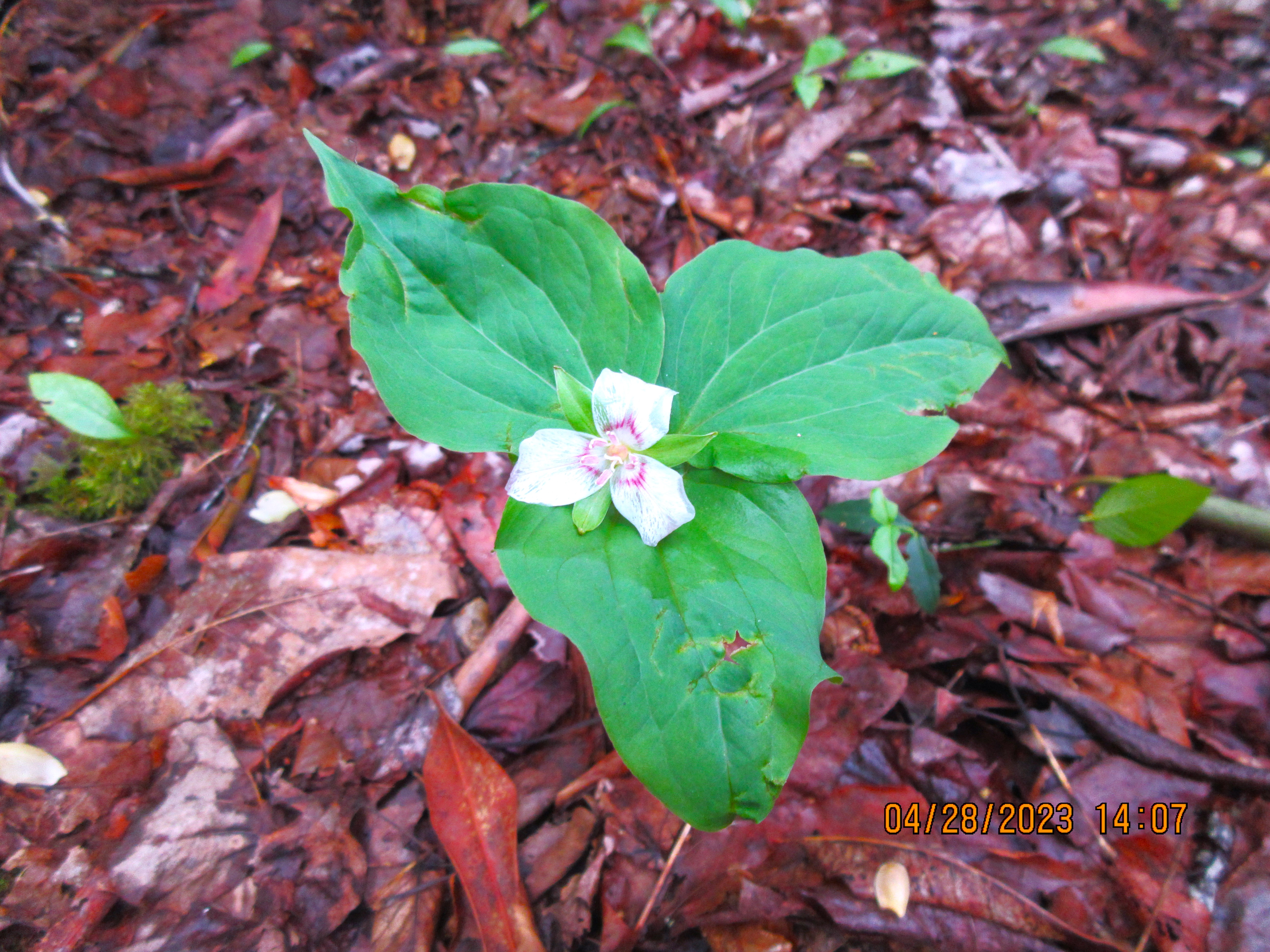
After a pleasant lunch break on the banks of Little River, our hike continued onto Cucumber Gap. This trail had a few Painted Trillium and many Showy Orchis.


On the final day, we are headed to Collins Creek for a Moss walk. Nanci and I were the only pilgrims to attend so it was a personalized walk with a couple UT botanists. I couldn't resist taking a photo of some Golden Alexander (above). 


Mosses were one of the first plants to emerge from the oceans onto land, 450 million years ago, They are found on every continent. They are non-flowering and produce spores to reproduce. They also don't have a root system. We picked a small single tuft to examine. When finished, it was placed right back where it came from so it could continue thriving. This rosette shaped moss was a particularly interesting one. 


Monday, May 8, 2023

Apr 21 Millford Plantation


Millford Plantation is only open to the public for 6 days out of the year and they sell out quickly. Today's tour is a private event arranged by Jessica Elfenbein as part of USC Wood Basket of the World conference. 


Ryan Spencer leads a discussion of the property while we have lunch on the lawn. Ryan is an employee of the Classic American Homes Preservation Trust which owns the home and several other classic American homes. We met a couple members of the previous owners, the Clark family. They had lived their whole lives on the property and are still employed there now. 


The land the home sits on was inherited by John Laurence Manning when his father died. Manning was still studying at Princeton at the time. Shortly after finishing his studies at South Carolina College, John married Susan Hampton, daughter of Wade Hampton I. She had already inherited a half interest in a sugar cane plantation in Ascension Parrish Louisiana when her father died a few years earlier. The young couple, both just 22 years old endeavored to build their grand home sparing no expense. They engaged a Rhode Island builder, Nathanial Potter to build it. Potter was already working in the area, rebuilding many buildings in Charleston following the great fire of 1838. The Mannings had Duncan Phyfe design and build all the furniture. Construction began in 1839 and they moved in the next year.


Greek Revival architecture was popular among the wealthiest of Americans. However, beyond that, the home has some incredible features for the era. Central heat was incorporated into the design. A spring supplied water, pumped into a water tower disguised as a lighthouse using leather lined lead pipes. From the water tower, running water was supplied to the kitchen and laundry. The grounds were landscaped with dozens of evergreen trees from throughout the world. The nursery bill for the trees still exists. 


The home was never a working plantation. The Mannings' income was from the Louisiana sugar cane plantation which enslaved over 600 Africans by 1860 making John Manning the 6th largest slave owner in the country. Susan died while giving childbirth in 1845. A few years later John marries Sally Clark of Virginia, just 19 years old. One of his love letters to her is on display. 


John is elected as a state legislator, then state senator, then governor. He also signed the South Carolina Articles of Succession. His copy was hidden behind a bookcase in the house during the war. John served as an officer during the war but by 1865 in the waning days of the Confederacy, he was back at Millford. Sherman had burned his way through South Carolina just to the west of Millford. By the time Sherman reached Fayetteville, he wanted to exact a greater toll from South Carolina's wealthy plantation holders in the eastern part of the state. Sending General Edward Potter to Georgetown and back, the excursion is now known as "Potter's Raid". Returning from Georgetown, Potter marched back to Fayetteville with 6000 freed slaves accompanying him as he burned plantations. On the day before the surrender at Appomattox, the general approached Millford. He was greeted at the front door by John Manning. After being introduced to the general, Manning is said to have replied, "This house was built by a Potter and now will be destroyed by a Potter". In one of the quirky footnotes of history, Edward Potter, brother of Nathanial Potter recognized his brother's work and spared the home. Had he known Manning had signed the Articles of Succession and a copy was hidden in the house, things may have been different. 


The Mannings continued to live in the home until 1869. Unable to afford maintaining the home, the Mannings moved elsewhere. The home was occupied by one of the former slaves for 20 plus years. She was the sole occupant and there was a nearby building occupied by another former slave. Manning died in 1889 and who occupied the home from then until 1902 is not clear. Heirs of John Manning sold the home to a wealthy widow from New York, Sally Clark Thompson. She renovated the home and used it as a winter retreat until her death in 1923. The Clark family continued to own the home until 1992. Richard Jenrette had made a fortune as a founder of Donaldson Lufkin & Jenrette and later head of Equitable Insurance. He was a collector of homes. During his life, he bought and sold close to 30 homes, keeping about a half dozen. He acquired Millford in 1992 after Hurricane Hugo had overwhelmed the area. His main residence was Edgewater on the Hudson in New York. Each year, he would leave there in the fall, occupy his Hillsborough NC home, Ayr Mount for a month, continue to Millford, then to Roper House in Charleston, then to his estate in the Virgin Islands. In 2008, he created the Classic American Homes Preservation Trust to maintain all the homes except the one in the Virgin Islands. 

The kitchen is attached to the home by a covered walkway.

The spring house is a small replica of Trinity Episcopal Church in Columbia. 

Water tower disguised as a lighthouse

Our approach to the home was the rear of the house. Kitchen is on the left and laundry on the right.


Sunday, April 16, 2023

Apr 11 Devils Marbleyard


Wow, just wow. This is a pretty stunning place. Devils Marbleyard is not marble but is a devilish jumble of rocks. I'm doing an 8.3 mile loop hike to visit the boulder field. Beginning at a small parking area at the entrance to Camp Powhatan, a boy scout camp now in ruins, I begin in chilly weather. The Belfast Trail takes me about a mile and a half to the beginning of the rock jumble. As I approach, I see what looks like smoke. As I draw closer. I realize it is not smoke. It is this pile of gray rocks.


I parked beside this bridge which led the way to the camp entrance. 


The camp which opened in the 1930s, now lays in ruins. There are many stone foundations and trails here. 


Shortly after passing the old camp you enter the wilderness. It is a very rocky uphill trail that leads to the boulder field. 


This is my first glimpse of the boulder field. My first thought was a glacier deposited these rocks. It reminds me of the erratic rocks of southern Connecticut, my home as a youngster. Of course that is not how they got here. One of my favorite bloggers, Mary Caperton Morton writes in her fabulous blog-Travels with the Blond Coyote:

So what happened here? As it turns out, the bizarre and beautiful geology of the Devil’s Marbleyard tells a story of ancient beaches, extinct worms, supercontinents and ice crystals. According to the U.S. Geologic Survey, the white rocks of the Marbleyard began as a white sand beach, much like the Outer Banks of North Carolina, around 500 million years ago. The sand was riddled with worms, which left behind copious worm-track tunnels as they moved through the sediment.

Over a period of several hundred million years, the beach was buried and the quartz-rich sediments were compressed and baked into quartzite, one of the hardest metamorphic rocks on the planet. A few of the worm tracks were preserved, all in one parallel plane; tracks in other orientations were obliterated.
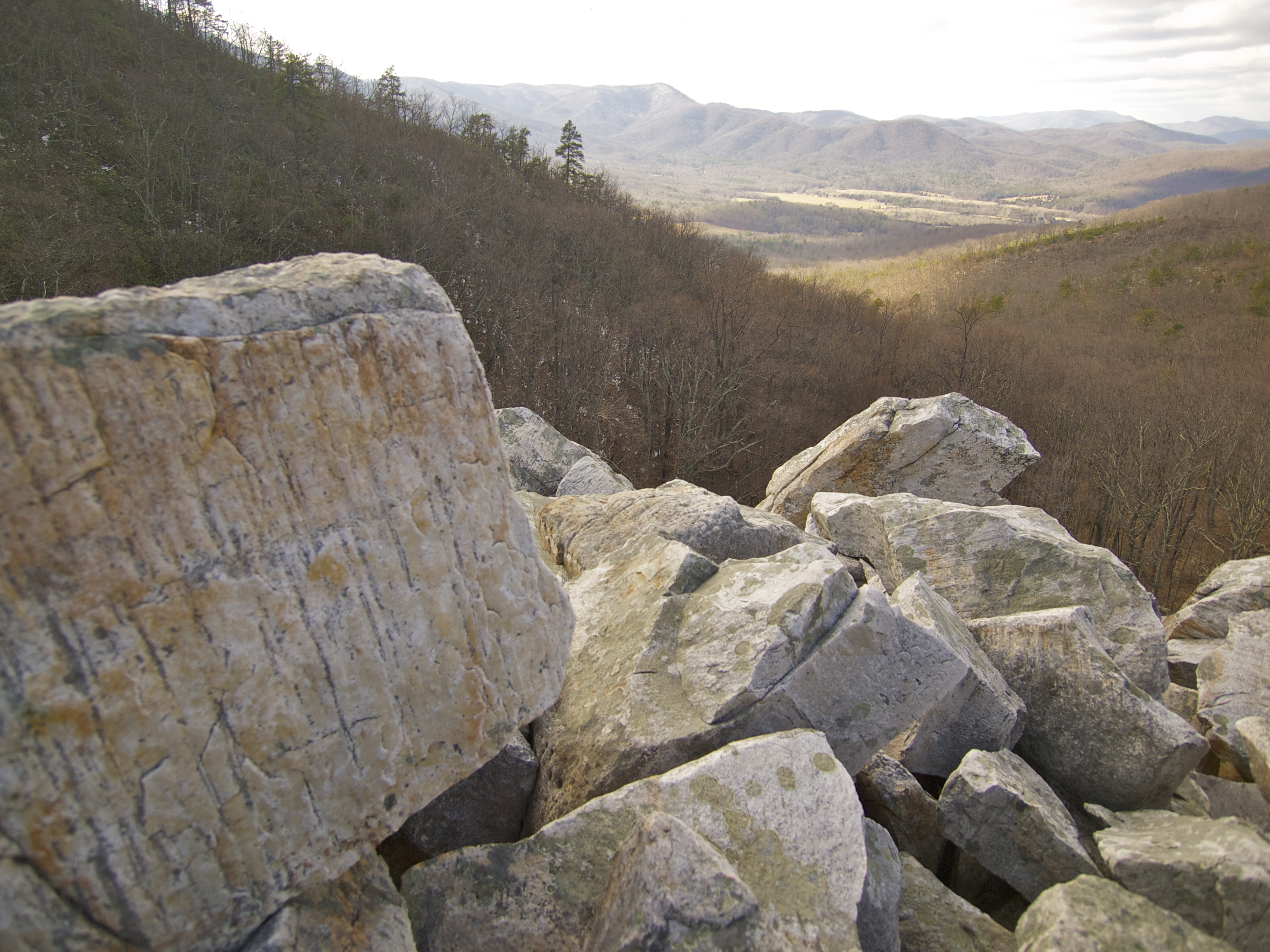
Looking back down into the Natural Bridge valley

Looking back down into the Natural Bridge valley, worm tracks on the left. This rock is classified by the USGS as Antietam Quartzite.

Then around 325 million years ago, the continental plate under what is now North America (then known as Euramerica) began colliding with the African plate (known as Gondwana), eventually forming the supercontinent Pangaea and pushing up the Appalachian Mountain chain to Himalayan heights.

For more than 200 million years, the hard quartzite of the Marbleyard lay intact, within the bowels of the mountains, until it was eroded to the surface, largely still in one piece. Then, ice went to work on the rocks, but not in the spectacular glacier-driven methods I imagined. Instead, tiny ice crystals found their way into cracks and fissures in the rocks, perhaps along the ancient worm-trails, and when the ice expanded, it cracked the rocks. Eventually, the entire quartzite ridge tumbled downslope, creating the Devil’s Marbleyard.

The moral of this story: given enough geologic time, worms can bring down mountains!

If you want a more fanciful account of the rocks' origin, another blog I follow is Virginia Trail Guide by Christine and Adam: 

 In the local tale, this area was occupied by Native Americans and the land was supposedly very green and lush.  There was a large stone altar at the top of this hill that was used for worship on full-moon nights.  A white couple met the Native Americans and they were thought to be spirits since they looked so different than the local tribes.  The couple said they were not spirits but they worshiped a higher power.  They converted the Native Americans to Christianity.  However, the next year brought about a great drought and the Native Americans felt the new God and the missionaries were to be held responsible.  They burned the couple alive on the altar.  As the flames reached high into the sky, a storm formed.  Lightning struck down upon the altar and exploded the rock over the mountainside.


The trail approaches the boulder field straight on but moves to the right to follow the periphery of the field. You can enter the rocks at several places but it is a tough scramble to move about. I have read that snakes occupy this area as you might expect. The rocks are of many sizes with the largest being as large as my pick-up. Nothing grows here as I imagine the boulder field is quite deep. Judging depth from the transition area, I's hazard a wild guess that it could be 20 feet deep. 


Eventually, the trail deviates lower and away from the rocks into a ravine. So, I did not get to see the top of the boulder field. 


The trail becomes less rocky and eventually ends at the AT. To the right (southbound) it is about a mile to "the helicopter pad", an open area with spectacular 360 degree views. However, recent trail comments indicate this area has overgrown and is no longer a scenic spot. So, I turn left and go northbound.


This is a ridge walk for a mile or more before heading downhill with 14 switchbacks. It is easy to see this on a map or gps track. The trail is fabulous with several viewing areas. It was loaded with a couple varieties of Azalea, Dog Hobble, Iris, Gay Wings and Birdsfoot Violets. 


The last 3 miles of my hike were on the Glendale Horse Trail. It was a wide two track, so a boring ending to an otherwise spectacular hike.


Jul 26 Caraway Creek

Very fresh Chicken of the Woods There must be a decaying log or stump below.  Laetiporus cincinnatus is the whiter version of this fungus. I...