Friday, May 13, 2022

Apr 28 Twin Creeks Science Center & House of the Fairies


Located a short drive from downtown Gatlinburg, in a rather inconspicuous location, The NPS houses many of its natural history collections in this 15,000 square foot building. Opened in 2007, I first visited a couple years later for a Wilderness First Aid course offered by the Appalachian Trail Conservancy. This visit was a brief tour of the collections and explanation the work preformed here.  


Our guide is Baird Todd, Park Curator. His job is to manage the collection. He is not so much a researcher as he is a caretaker. This room may look like a laundromat, but it is more an important repository for tens of thousands of specimens collected in the park. Some are donations are from private collections. Baird must make sure these specimens are preserved as well as possible. He explained the quarantine process when new specimens are received, what substances are used the preserve specimens and climate control of the room's environment.  
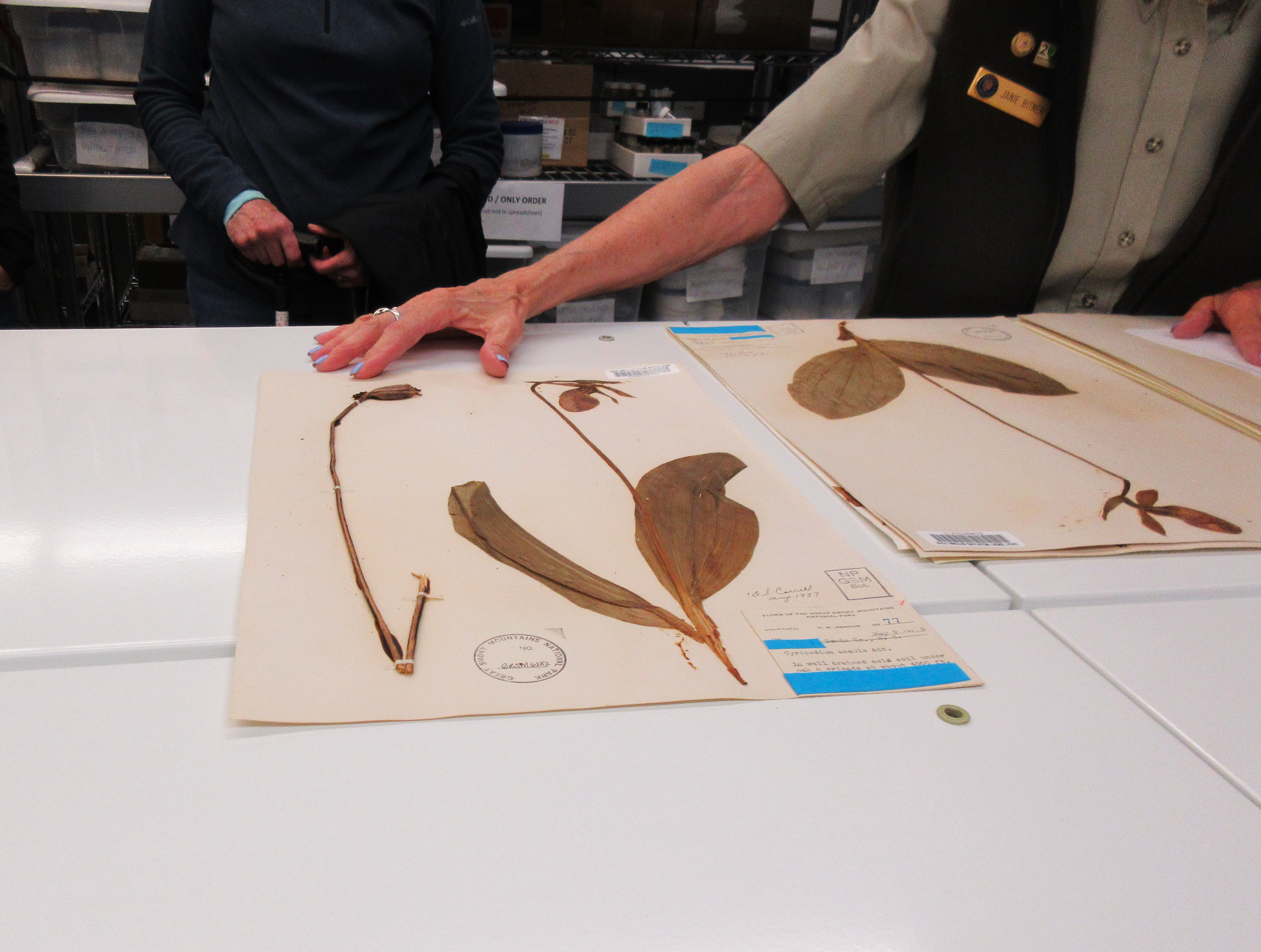

The park does maintain an herbarium of plants but the herbarium at University of Tennessee houses a much larger collection. Nevertheless, the park's collection is an important record of what is growing and has grown in the park. Currently, the collection is being digitized. 


While viewing some of the bird specimens, Baird says there is a growing consensus that birds collected 50 or more years ago had more vibrant colorations. It is thought that air pollution has dulled their colors. 


This cabinet contains "wet" specimens. Snakes, salamanders, frogs and their allies are stored in alcohol. The largest jar in the cabinet contains a Hellbender collected in 1940. It measures over 70cm (28 inches) long.
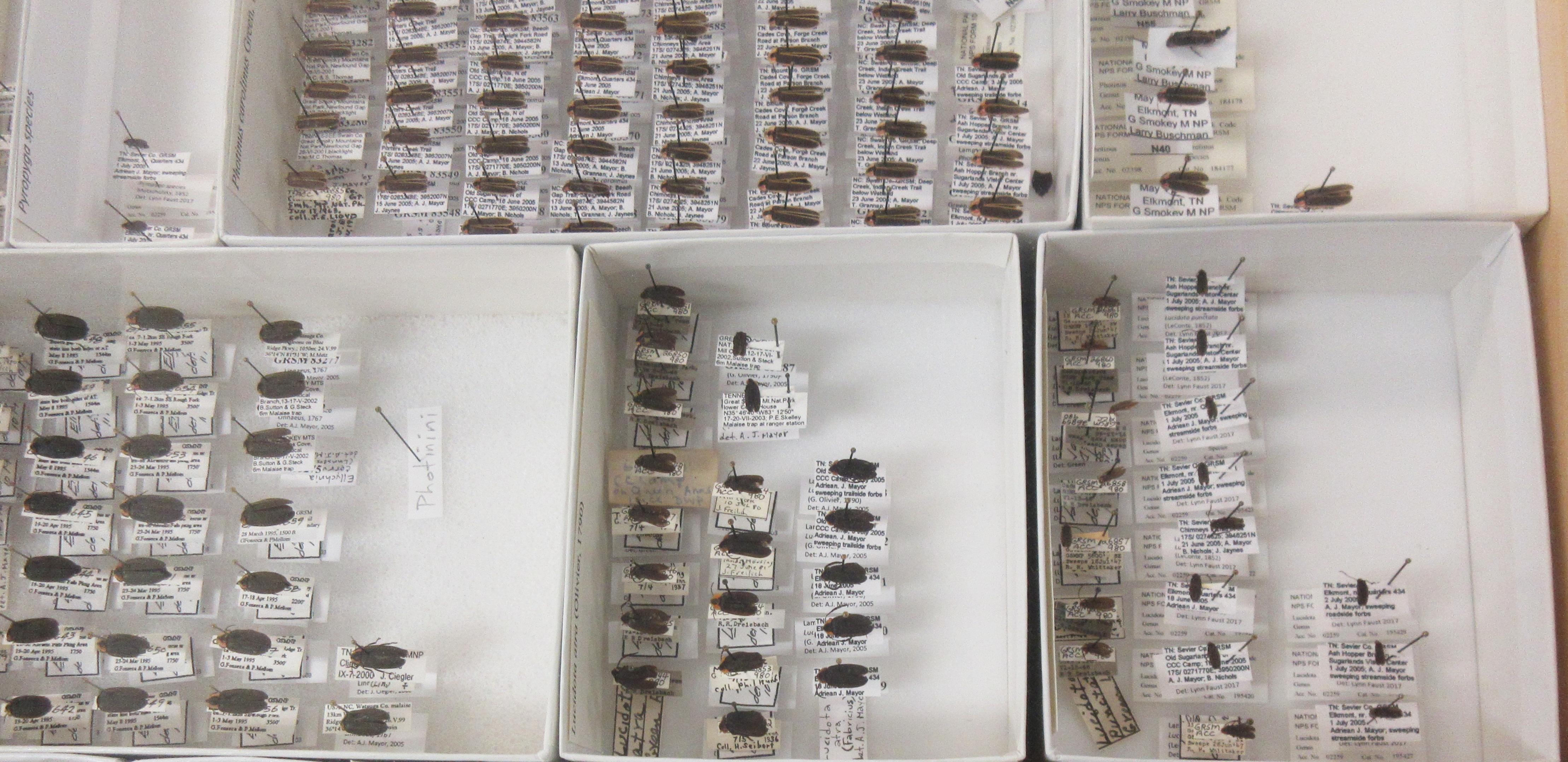
The Park's firefly collection

Baird explained that his specialty is cultural history items, although they are not housed in this building. That collection is stored at another facility in Townsend. That collection houses furniture, clothing, tools etc. A sizeable part of that collection came from the Walker Sisters of Little Greenbrier. The Walkers had 11 children in the late 1800s, seven of them girls. By the creation of the park, 5 sisters survived and were given a lifetime lease to stay on their farm. None ever married and they carried on farm work as they always had. They became minor celebrities and many park visitors would visit them out of curiosity. The last sister died in 1964. What items left in the household, were purchased by what is now, the Smoky Mountain Association and donated to the park.


Passenger Pigeons were declared extinct over 100 years ago. This one was collected in the 1840s. In 1833 James Audubon declared that the Passenger Pigeon the most numerous bird species in the North America. It was estimated that there were 3 billion of them and they made up about 1/3 of all birds in North America. They were completely wiped out of the wild by 1900 and Martha, the last survivor in captivity dies in 1914.     

The main room of the building filled with work cubicles. 


After our tour, we walked a short distance to the so called, "House of the Fairies". It was a spring house built around 1930 as part of the Voorhis estate which occupied the area prior to creation of the park.


Thursday, April 28, 2022

Apr 27 Gabes Mountain Pilgrimage


Bear Corn in full bloom

An epic wildflower hike on the first day of Spring Wildflower Pilgrimage 2022 ended the 2 year pandemic drought of my favorite event. It was so exciting to start this year's event off with a hike on Maddron Bald and Gabes Mountain trails. Our walk was led by Carol Ann, director of the NC Herbarium at Chapel Hill and Theresa, an enthusiastic high school biology teacher. We had several other quite knowledgeable botanists along as well. There was a particular interest in tree identification. Silverbells, Buckeyes, Magnolias were all in full bloom.

Stonecrop

We began with a van ride from Cosby picnic area to the Maddron Bald trailhead. The first 1.2 miles of the hike was a slow walk at botany pace on the gravel road which Maddron Bald Trail begins on. The park service still uses this road. The most prevalent vegetation along here was poison ivy.


The first exciting find of the day was One Flowered Cancer Root, a parasitic, non-chlorophyll plant. They are quite subtle and can get lost in the dense vegetation. We probably saw at least a half dozen during the day. More than I have ever seen in one area.

One Flowered Cancer Root side view

Just after passing the Baxter cabin at .7 mile, we passed a display of Daylilies (not blooming), indicating a former homesite. Shortly we were at the trail junction with Gabes Mountain trail where I spotted the Pink Lady Slipper below while answering nature's call. 


We saw brilliant displays of Bishop's Cap, Foam Flower and Brook Lettuce at stream crossings. Gabes Mountain Trail wanders through a diverse forest of large trees. I wondered if portions had been spared the timbering spree in the early 20th century. Nearby Albright Grove was also spared. The massive hemlocks in this area are in various stages of the adelgid aftermath. Some still standing and many laying on the ground decaying into the earth. 

Foam Flower made many appearances today

Bishops Cap display

Dwarf Ginseng

The sculpted bark of a Buckeye 


We sat in a sunny spot for a lunch break. Warblers, Vireos and a Mountain Wren entertained us in the background.

Wild Geranium

Shortly after lunch we walked through a beautiful display of Wild Geranium and a solo Yellow Lady Slipper. 

A showy display of Showy Orchis


Midafternoon found us finally at Henwallow Falls. We had crossed the creek which puts on this display about 4 times before reaching this spot.

Painted Trillium

After the waterfall viewing, the group split apart for the final 2 miles back to Cosby. The wildflower displays were over for the most part. We did spot 2 Pink Lady Slippers at about the final half mile mark.


Fabulous walk in the forest today.


Sunday, April 24, 2022

Apr 24 Walker Creek Wildflowers


                                                                            Sweet Shrub

New York Ferns


I knew these were there and wanted to see them in bloom. I missed peak bloom but saw enough to make the hike a success. Golden Club, a plant I don't see often, is an aquatic usually in shallow water. These were in an abandoned bed of Walker Creek in which the water backs up into the bed. They have a long golden spadix with minute flowers.


Right next to the Golden Club colony there were many Jack in the Pulpits.


Here is how the Jack starts off, blasting its way up from the earth.


Mountain Laurel buds


Yellow Star Grass


Apr 17 Mayo River Wildflowers


Waterfall at Deshazo Access

Dwarf Ginseng

All the wildflowers were seen at the Hickory Creek access.


Wild Ginger

False Rue Anemone 

Brook Lettuce

False Rue Anemone 

Showy Orchis

Apr 15 Uwharrie Wildflowers


Golden Ragwort

Devils Urn

Viburnum 

Bluettes

Foam Flower

Wild Ginger

Blue and Gold

Wood Sorrel


Sep 9 Jostedal Glacier - On the Ice

  Our guides for the hike today are from Nepal. We are on the Jostedal glacier. The largest glacier in Europe. The ice is dirty and granular...