Wednesday, June 19, 2024

Jun 15 Crystal Lake Paddle


Another paddle organized by Crystal Cockman and Three Rivers Land Trust. Once again, I have used Crystal's photos here.

Pickleweed

Crystal Lake is a 57 acre lake in Moore County near Lakeview and Vass. Is it named for Crystal our leader? No. In 1830 Duncan Blue dammed Mill Creek for a gristmill. The smaller pond was know as Blues Lake. In the 1880s when the the railroad opened up the area, Reverend Martin McQueen bought the property. The pond was renamed McQueen's Mill Pond. Later in 1902, Boston businessman Harvey Holleman bought the property and enlarged the pond to its current size. He renamed it Crystal Lake and began developing it into a resort like many of the other towns in the area had been developed since the 1880s. Property was going for $1.50 an acre and Holleman bought 1000 acres surrounding the lake. At the time is was the largest lake in Moore County. Lakeview was developed and thrived as a resort for some time. The railroad runs by the east side of the lake so that became the hub of the resort.


After paddling across the lake, we entered a Black Gum swamp. The temperature seemed to drop 10 degrees. The paddle trail is marked with some survey tape here and there. We bumped along several submerged logs. Charles, above, helped everyone through a log jam. The few paddleboards with keels had a time getting through. A bit further we encountered a couple downed trees which we could not get through. 

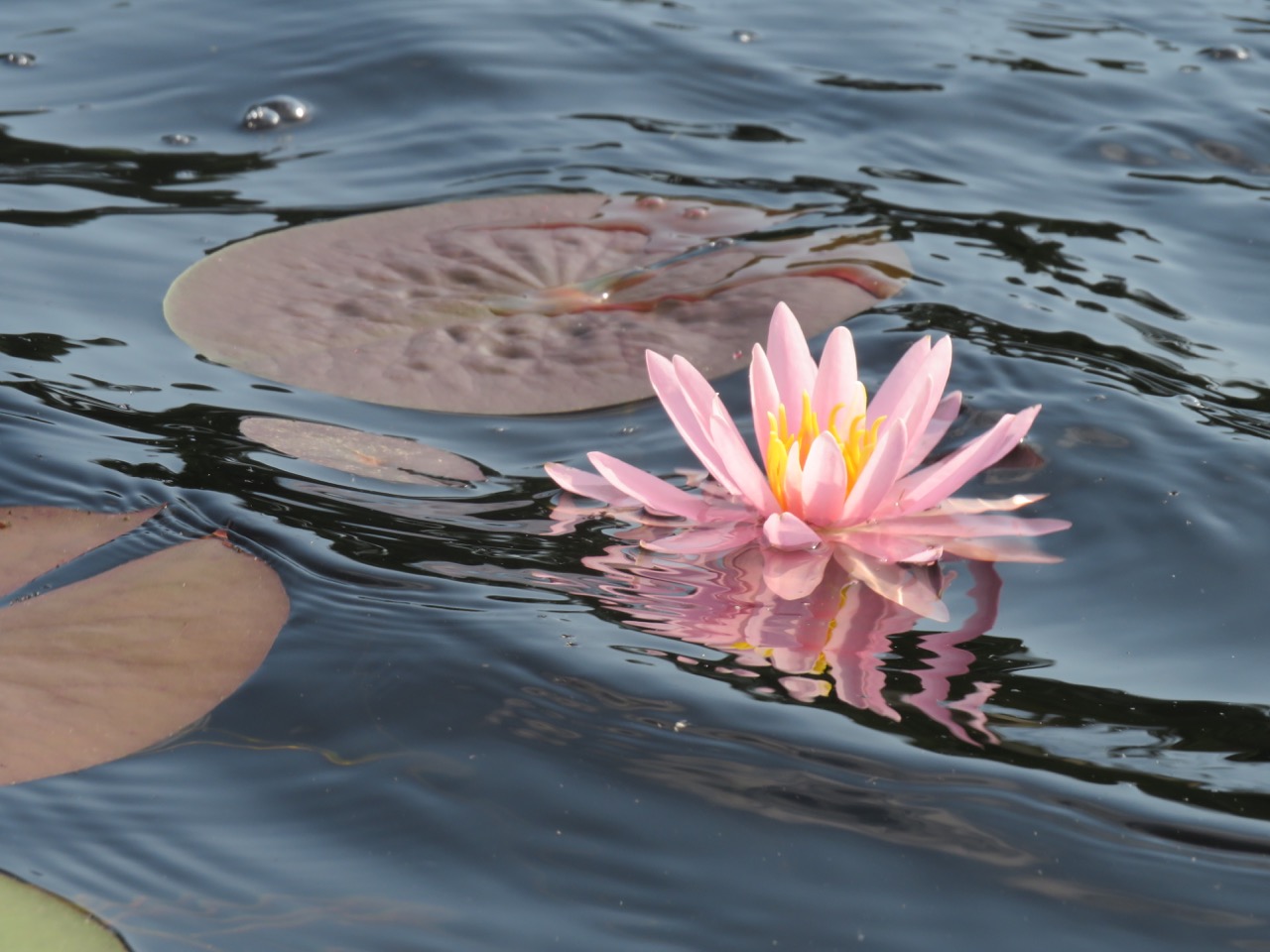
American white water-lily

The swamp was dotted with very small islands which supported single Black gum trees. On one of these islands, Will spotted a Water Moccasin snake which we observed from a good distance. It was very well camouflaged. 


I suspect our paddle was in the order of 2.5 miles. The swamp was very relaxing to float through. With more than a dozen boats, single file through the narrow passage meant a lot of standing still listening to birds and the traffic on nearby Rt 1. 

Jun 8 Little River Paddle to Capelsie and back


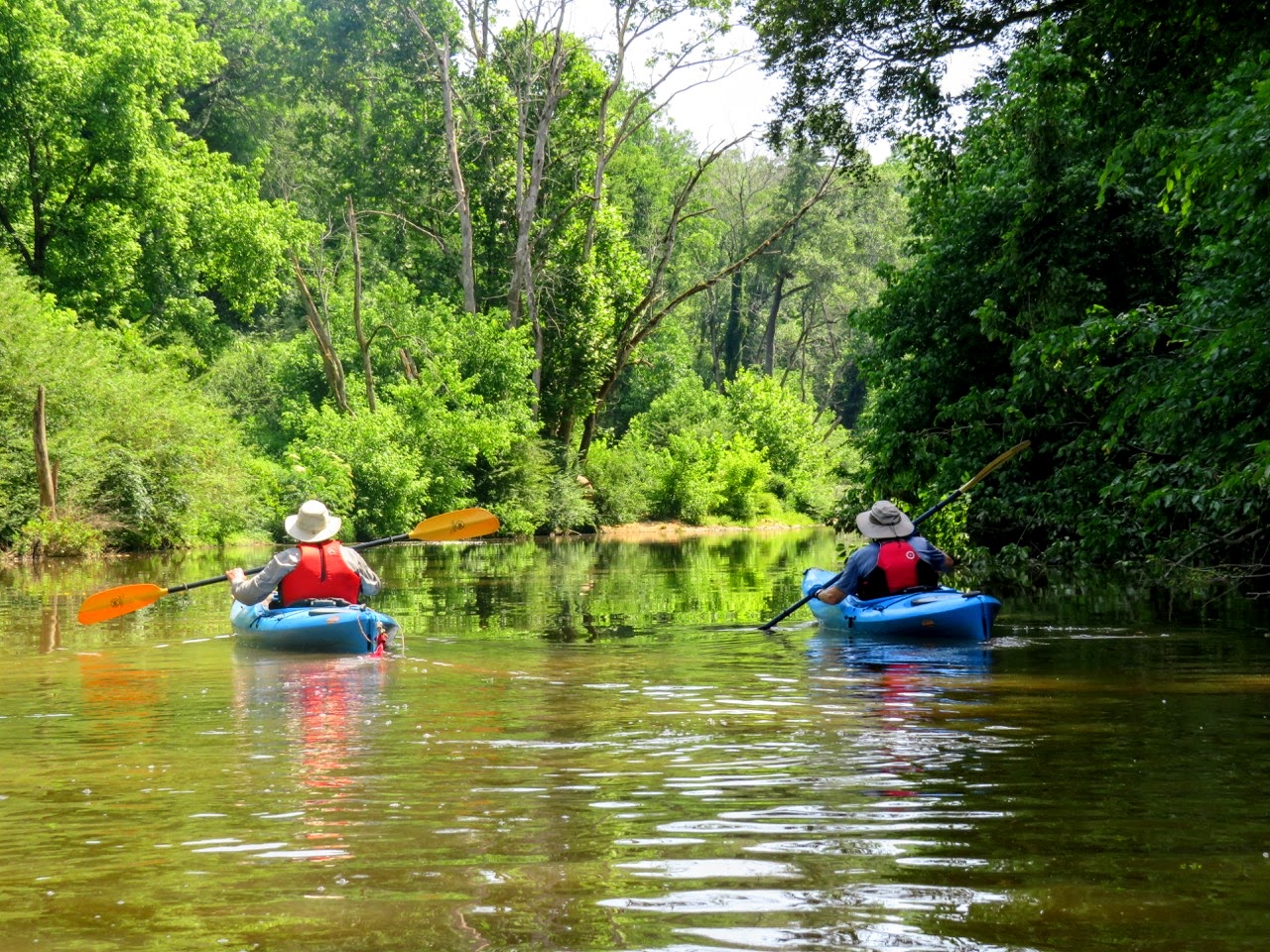
Today's paddle is on the Little River near Troy. We are in the backwater of a dam, paddling upstream a couple miles to another dam. There was a very slight flow so paddling upstream was about the same as downstream. 

This paddle was organized by Crystal Cockman of Three Rivers Land Trust. I have used her photos here.


The river narrowed and we needed to paddle hard and maneuver around rocks as we approached the dam. Hidden in the foliage on the the left of this photo are the remains of the Capelsie Mill which the dam provided the power for. It dates to 1898 when A W Capel began spinning cotton into yarn. That business did not survive the Great Depression, closing in 1931. Several years later in 1935, AW's son A Leon Capel bought the mill to make braided rugs. He had started the business as a teenager back in 1917 making braided rugs with second quality and closeout yarns. His father's business had been the source for some of his yarn needs. This was the first manufactured braided rugs. Braided rugs had been around for a long time but they were handmade with scrap cloth. The business thrived and is still in around today. Capel Rugs no longer are made in the mill. It has been abandoned for some time now.


Prothonotary Warbler

Here is an interesting piece about the bird copied from Wikipedia:

The prothonotary warbler became known to a wider audience in the 1940s as the bird that established a connection between Whittaker Chambers and Alger Hiss in front of the House Un-American Activities Committee.

On August 3, 1948, in a hearing before the committee, Chambers accused Hiss of being a communist spy who sought to infiltrate the U.S. government. Two days later, Hiss testified before the committee and claimed, among other things, that Chambers' allegations were false and that he did not know Chambers.

However, future U.S. president, Richard Nixon, who was then a freshman congressman on the committee, became convinced that Hiss had committed perjury at the hearing. To verify this suspicion, the committee had Chambers appear before it again on August 7, 1948, to testify about his relationship with Hiss. At that hearing, Chambers testified that Hiss enjoyed bird-watching, and once bragged to Chambers about seeing a prothonotary warbler along the Potomac River. When Hiss appeared before the committee again, he haphazardly confirmed spotting a prothonotary warbler on the Potomac, causing many members of the committee to become convinced of the pair's acquaintance. Ultimately, the Hiss-Chambers hearing led, in part, to Nixon's political rise.


The star of the show today is this Green Heron. It fled into the foliage on our upstream paddle but posed nicely on our return visit. Often you see them with the neck all scrunched into the body looking as if they don't have much of a neck. Green Herons, like some other herons, can use bait, like a twig dropped in the water to lure fish. 


Tuesday, June 4, 2024

Jun 1 National Trails Day Hikes


Trailblazers hobnob on Little Long Mountain

I am starting the day off at Joe Moffitt Trailhead to hike with Three Rivers Land Trust up Little Long Mountain. The Land Trust was instrumental in acquiring the land and transferring it to the National Forest Service. Prior to the transfer, the Uwharrie Trailblazers helped build the Uwharrie Trail through here. The shelter was an Eagle Scout project of Hampton Routh back in 2015.

Nuttals Sensitive Briar

Eagles Nest Shelter atop Little Long Mtn


Lots of Bee Balm here


After leaving Little Long Mountain I headed to Ridges Mountain State Natural Area where the NC Zoo was having an open house. There were so many cars here, they were parked all the way out to the paved road. I walked up to the zoo's tent to find it manned by Bob and Betsy and soon after I ran into Mary Joan and walked the preserve with her.


MJ squeezes into the rock

Now, I try to squeeze my way through.

MJ told me that Ben Crotts, the former owner of the big rocks, had given her a list of names for the rocks. Apparently, he had names for them all. MJ says that document is with the zoo. 


The cave mentioned here has never been found. MJ told me that during the original purchase (Kenan not Crotts), Glenn Kenan motioned in a direction and said, that is where the cave is.

There is Charles on top

Brand new kiosk at Ridges Mtn


Monday, June 3, 2024

May 29 Rocky Face Mountain


Today's hike is at Rocky Face Mountain Recreation Area in Alexander County. Another flat rock community. This one goes by a cumbersome name -  Low Elevation Granitic Dome and Montane Red Cedar-Hardwood Woodland. The rock, a granitic gneiss, is the focus of the park. It was a quarry for a while 80-100 year ago. A prison camp was located here too. Now it is a hikers and rock climbers paradise. Trails crisscross the park. A playground with a giant slide keep the kids busy. A large parking area, restrooms and a multi purpose building round out the amenities.

Next to the parking area are remnants of the quarry.

Lots of open face rock

Prickly Pear in bloom

On top looking out at Alexander County

Striped Garlic found only in the southeast US

Nearby


May 28 Bluff Mountain Preserve


One of the starring roles at Bluff Mountain Preserve is played by Pink Lady's Slipper. They occur throughout the 3 mile hike which the Nature Conservancy uses to showcase the Preserve. Although, now 3000 acres, we probably stayed within a 300 acre area, hiking a big loop. Our tour began after a bumpy 1 mile ride up a steep and rocky one lane road. My AWD Honda Accord did ok but it was close to its limit. Others in our group rode up with Kelly Clampitt, the Nature Conservancy's Ashe County Steward. I've gotten to know Kelly fairly well, after 4 tours with her.


After parking our vehicles near the fen, we began hiking in a meadow of Scarlet Indian Paintbrush. I have never seen them anywhere but here. Melissa, one of our group said it was like walking on sacred ground. So many rare and beautiful flowers and plants are located here. 


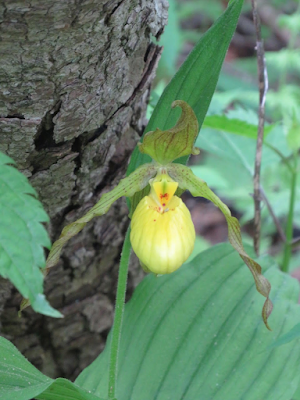
We took a side tour to see some Yellow Lady's Slippers. They were still in bloom but on the way out. 

Scarlet Indian Paintbrush

On a previous visit we saw a Yellow Indian Paintbrush but not today. 


Our first major viewing spot is on an exposed rock at about 4500'. On a previous visit, we were able to see some Spreading Avens here. It was too windy to climb out on the rocks today to spot them. They are in the rose family and found only in 15 locations along the NC and TN border. Its species status is G2 - Imperiled. 


Out of the wind, we made our way to the Edwards' cabin for our lunch break. The Edwards family sold the property in 1987 to the Nature Conservancy but retained the rights to access their cabin. The small pond nearby empties into a creek which within a very short distance plunges 400 feet down. The waterfall is not visible other than a glimpse of the top and bottom. 


There are only 3 High Elevation Mafic Glades in the world. The other two are on Mt Jefferson and Buffalo Mountain. High Elevation Mafic Glades are very rare glade communities of high elevation amphibolite or hornblende gneiss outcrops. They have patchy shallow soils that support a mosaic of grass and shrub vegetation alternating with bare rock and lichen cover. They tend to be dry due to the shallow soil but often the surrounding area is wet and fertile as the water and nutrients seep off the rock. 


Stepping stones in the fen

The Bluff Mountain Fen is a 2.5 acre high elevation Southern Appalachian Fen. This globally rare wetland type is only known to exist at this location in the Southeast United States. The Fen is located on a 25 acre high plateau and fed by a number of springs and seeps forming a headwater catchment to the New River. An unusual combination of circumstances led to the development of Bluff’s fen - a high plateau with a shallow depression, a hard bedrock that resists erosion, extreme climate, and a constant supply of nutrient-rich water draining from the upper slopes of Bluff’s main ridge. These extreme fen conditions have probably prevented the invasion of shrubs and trees, and have fostered the development of at least 13 distinct herbaceous plant communities. 

 Over 140 species of vascular plants and mosses have been recorded from the fen, including more than a dozen species considered rare or endangered in North Carolina. Northern fen species reaching their southern limit intermingle with southern species reaching their northern limit - a unique association. Ecosystems surrounding the Fen include an intact Carolina Hemlock Forest, a dwarf red oak – white oak forest, and a rare High Elevation Mafic Glade community.

The 400' vertical drop


I think this is an Eastern Newt swimming in the Edwards' pond. Newts start out in the water but then have a terrestrial period as an Eft but end up back in the water as adults. 


The High Elevation mafic Glade is next to the Hemlock Forest. The Hemlocks here look so healthy they don't even seem like Hemlock trees. The needles are so brilliant and look alert. Named Hemlock because its foliage when crushed smells like the poisonous hemlock plant of Socrates fame. Socrates was accused of impiety, found guilty and sentenced to death by drinking a Hemlock beverage. 


Named for the 3 stripes on its body, the Garter snake is a harmless and beneficial snake to have around. We saw 3 today. 


Bluff Mountain Reindeer Lichen occurs in the glade and nowhere else on earth. 


Insectivorous Round-Leaved Sundew is found in the fen. Crystal's camera makes it look pretty big but it is a tiny plan that you would never know is there unless you are looking for it.  


Jul 26 Caraway Creek

Very fresh Chicken of the Woods There must be a decaying log or stump below.  Laetiporus cincinnatus is the whiter version of this fungus. I...